> For the complete documentation index, see [llms.txt](https://learnphp.gitbook.io/learnphp/llms.txt). Markdown versions of documentation pages are available by appending `.md` to page URLs; this page is available as [Markdown](https://learnphp.gitbook.io/learnphp/learn-lavarel/laravel-9-scout-full-text-search-tutorial-ok.md).
# Laravel 9 Scout Full Text Search Tutorial (ok)
https\://www\.itsolutionstuff.com/post/laravel-9-scout-full-text-search-tutorialexample.html
Hi Dev, Laravel 9 Scout Full Text Search Tutorial
In this tute, we will discuss laravel 9 scout full text search example. you can see laravel 9 scout search example. you will learn laravel 9 scout elasticsearch example. Here you will learn how to add full text search in laravel 9 scout. Let's get started with laravel 9 scout database engine example.
Laravel 9 provides Scout Package for full text search from your project. If you require to add full text search function in your laravel 9 application then you have to choose scout package to do.
In this example, we will install the scout composer package and use the database driver for full text search. then we will use scout with User model and add a name, email, and id column for full text search. let's see the below step to create full text search function.

**Step 1: Install Laravel 9**
This is optional; however, if you have not created the laravel app, then you may go ahead and execute the below command:
```
composer create-project laravel/laravel example-app
```
**Step 2: Install Scout**
In this step we have to install scout package and we will publish them:
```
composer require laravel/scout
```
Next, we have to publish our configuration file. so you need to run bellow command:
```
php artisan vendor:publish --provider="Laravel\Scout\ScoutServiceProvider"
```
Now we need to set configuration database as driver in your env file:
.env
```
SCOUT_DRIVER=database
```
Read Also: [Laravel 9 Image Upload Example Tutorial](https://www.itsolutionstuff.com/post/laravel-9-image-upload-example-tutorialexample.html)
**Step 3: Update User Model**
Here, we already have users table created, so we need use "Searchable" and create toSearchableArray() method. so let's update following code:
app/Models/User.php
```
'datetime', ]; /** * Get the indexable data array for the model. * * @return array */ public function toSearchableArray() { return [ 'name' => $this->name, 'email' => $this->email ]; }}
```
Next, we will create some dummy records on users table and import it.
so let's run following commands:
Create Dummy Records:
[](https://go.ezodn.com/ads/charity/proxy?p_id=5cd53513-2d89-4e5a-6f38-829b7d69b292\&d_id=77568\&imp_id=2846957860100009\&c_id=1079\&l_id=10016\&url=https%3A%2F%2Fwww.directrelief.org%2Femergency%2Fukraine-crisis%2F\&ffid=1\&co=VN)
```
php artisan tinker User::factory()->count(20)->create()
```
Import Records:
```
php artisan scout:import "App\Models\User"
```
**Step 4: Create UserController Controller**
In this point, now we should create a new controller as UserController. In this controller, we will add index method, that will return users with filter.
Let's update following code to your controller file:
app/Http/Controllers/UserController.php
```
filled('search')){ $users = User::search($request->search)->get(); }else{ $users = User::get(); } return view('users', compact('users')); }}
```
**Step 5: Add Route**
In this is step we need to create route for listing users. so open your "routes/web.php" file and add following route.
routes/web.php
```
Laravel 9 Scout Full Text Search Tutorial - ItSolutionStuff.com
Laravel 9 Scout Full Text Search Tutorial - ItSolutionStuff.com
ID
Name
Email
@foreach($users as $user)
{{ $user->id }}
{{ $user->name }}
{{ $user->email }}
@endforeach
```
**Run Laravel App:**
All the required steps have been done, now you have to type the given below command and hit enter to run the Laravel app:
```
php artisan serve
```
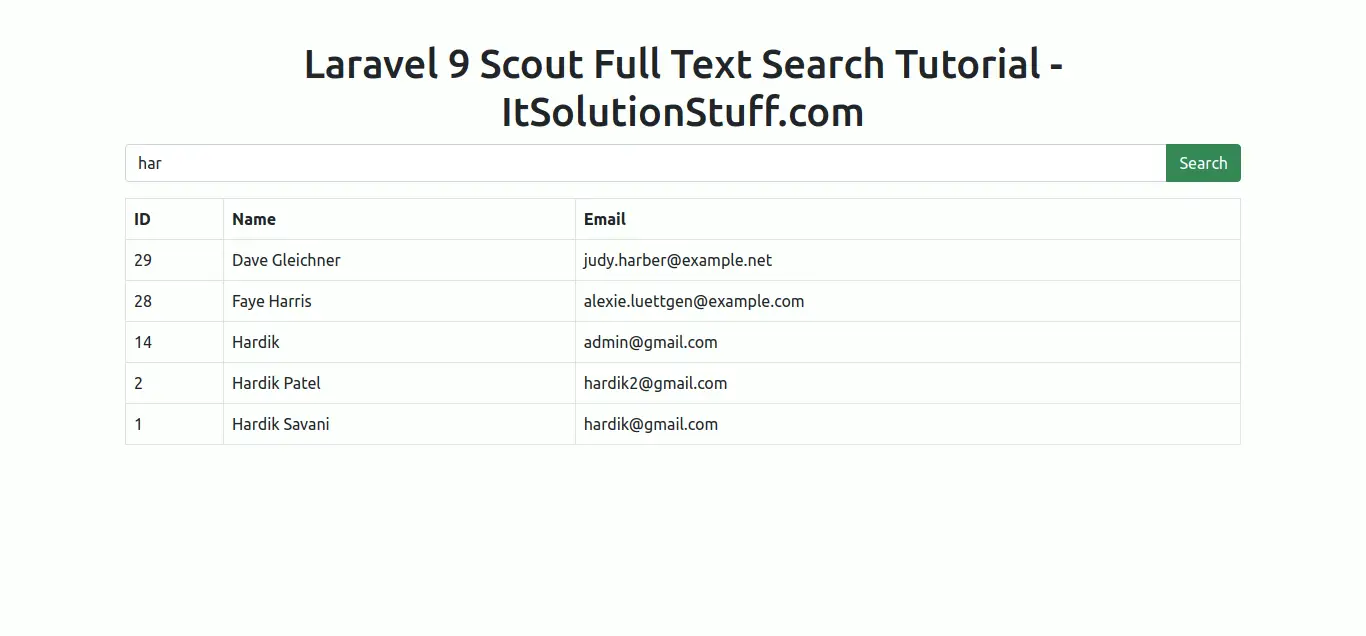
Now, Go to your web browser, type the given URL and view the app output:
Read Also: [Laravel 9 Drag and Drop File Upload with Dropzone JS](https://www.itsolutionstuff.com/post/laravel-9-drag-and-drop-file-upload-with-dropzone-jsexample.html)
```
http://localhost:8000/users
```
Output:
Maybe it can help you.....